
“It’s time to share my story. Something that I’ve been holding on to for many years. Disappointment, heartbreak, thoughts of shame and guilt, surviving and yet times of thriving, joy, courage, and victory.
This story is mine – and likely many of yours, in some way, too. It’s about the truth of my childhood, a sense of time lost, what I’ve overcome, and who I’m still becoming.
Sharing this is a challenge.
It’s something that’s been on my mind and held close to my heart for fear of what others would think.
It also challenged me to speak out, be authentic, and embrace it in hopes of being a voice for others and showing that I’m much more than the physical challenge.
We all are.” – Donna Adinolfi
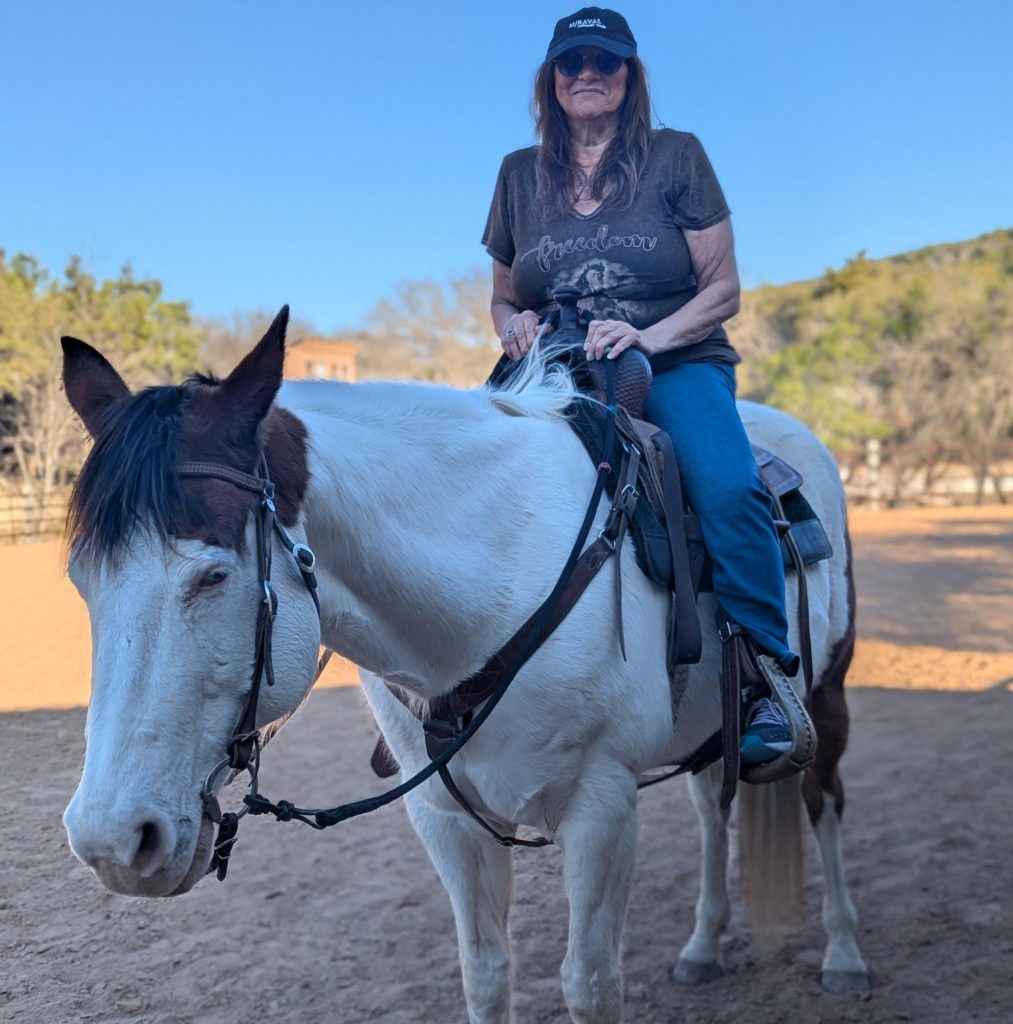
Donna is a travel journalist, photographer, and founder of Mindful Adventures. She’s been in the travel industry for over 40 years and has focused on wellness for the last 26 years where she encourages and plans transformational travel for health and healing, personal growth, self-care, and mindful living.
She started Mindful Adventures in 2000 shortly after her journey at Miraval Arizona, a wellness resort she has worked with for many years, and reaffirmed her interest and passion a few years later when she saw how experiencing Rancho la Puerta, another wellness resort, helped to improve her husband’s health. Sadly, he passed since then from complications with diabetes.
Her vision continues and her hope is to inspire others to create a healthier lifestyle – body, mind, and spirit – through her knowledge and experiences.
June 16 is the 60th anniversary of the osteotomy surgery Donna had in Toronto at five and a half years old, which led her to be able to walk. She was one of Dr. Robert Salter’s patients at the Hospital for Sick Kids. Since then, she had a preventative surgery after college with Dr. Salter in Toronto, which was likely a pelvic osteotomy and similar to today’s Ganz periacetabular osteotomy (PAO). A right hip replacement was performed in 2012, a left knee replacement in 2016 due to an injury, and ultimately a left hip replacement in 2022.
Donna attempted to track down records of her surgery that occurred after college, which she had in 1983 before the first known PAO was performed in 1984. While “mechanically” a success, she said the surgery had a negative impact on her glute medius and the muscle has never been the same. She has done physical therapy, cupping, manual therapy, dry needling, and exercises to help improve the muscle’s function and more recently shockwave therapy (sound waves), which has been beneficial.
Here, Donna tells us about growing up with hip dysplasia, navigating challenges, finding a sense of adventure and piecing together her medical history.
Q: What is something positive that has come out of your hip dysplasia journey?
Donna: Compassion and empathy. I’d like to believe that I still would’ve lived with compassion and empathy if I didn’t go through this. But it certainly is something I’m aware of and have shown to others through my life.
One of the most positive things is my sense of adventure. Thinking back, having been on an airplane for the first time at five-and-a-half years old in the mid ‘60s for the flight to Toronto was a profound experience leading me to focus on my career in travel and the opportunity to interview with American Airlines.
The flight attendants took my info. I had no idea they were going to do that. They took my info, and at some point (around six years old), in the mail, I got this certificate that said when I turned 21, I would have an automatic interview with American Airlines.
I still have the letter in a faded envelope with the flight attendant’s name. So, I want to think that maybe I wouldn’t have been interested in travel if I didn’t take that flight.
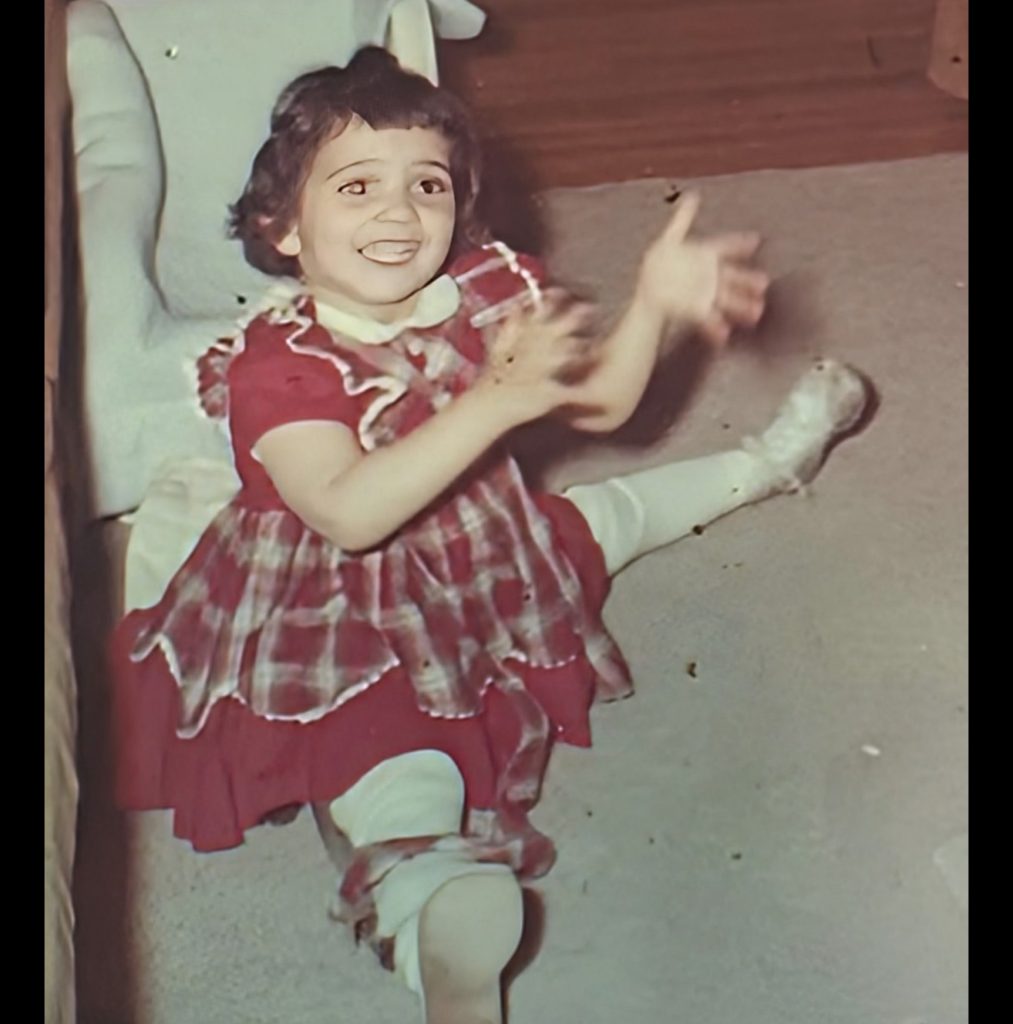
Donna at 3 years old in the “hip split.”
What has been your biggest challenge related to hip dysplasia?
The biggest challenge goes back to when I was younger, and kids would just be mean and make fun of the way I walked. It got better, but that was a painful time, emotionally.
Another challenge, noted earlier, is that one of my surgeries as an adult caused damage to my gluteus medius muscle, and it’s never come back a hundred percent. I believe there’s hope for it to improve.
[But that surgery] in 1983 was different. And I’ve already talked to the hospital. I took it as far as I could and there are no records. They’re gone. I don’t know why they couldn’t digitize them, but I guess 43 years ago is too long. So that ship sailed, which frustrates me to be honest with you, because I could not get more details about that surgery.
I turned 65 in October, and my muscle is stronger, but I still don’t walk the way I hoped I would by now. And so those feelings have all come back over the last however many years.
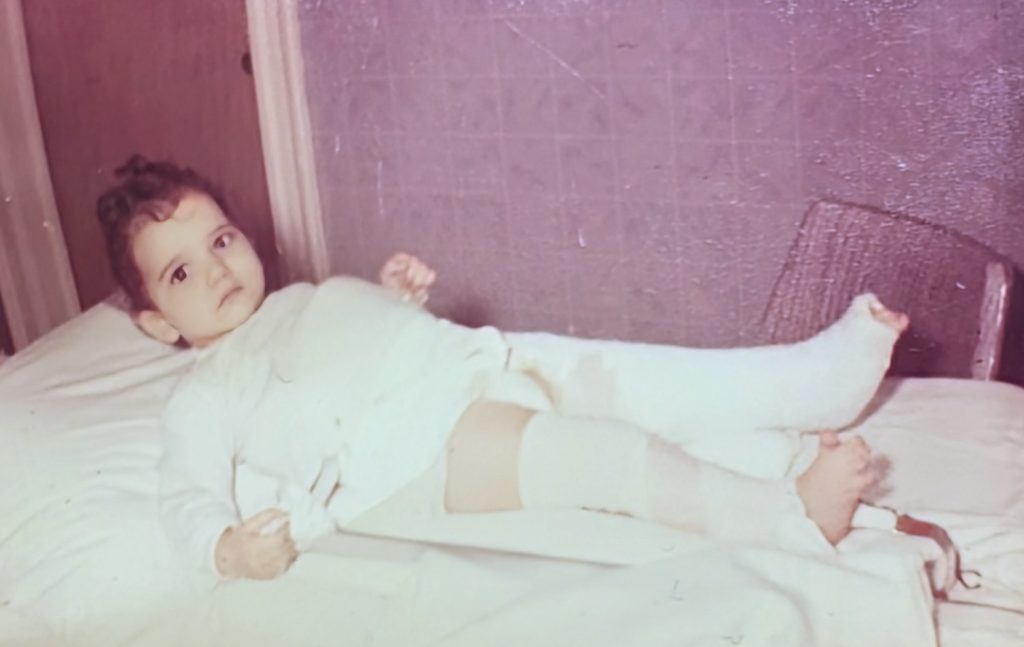
Equally challenging is when I think about the sacrifice my parents made, especially my mom as she stayed in Toronto for the two months I was there for surgery and recovery when I was five and a half years old, leaving my younger sister and brother in New Jersey with my dad, aunts and grandparents. I’ve always felt guilt about that, even though it was out of my control. It’s something I’ve always carried with me.
And the day of my surgery was the same day [my mom’s] father passed away, my grandfather. One memory that has always stayed with me is that my mom said, “We’re not leaving until she walks out of the hospital.” And I did, after months of physical therapy and follow up. My mom was amazing, and I’ll always be grateful for my parents.
What opportunities do you see for patients and families to get involved in hip dysplasia advocacy?
Raising awareness through social media, getting involved with Miles for Hips’ Day of Movement, volunteering with the International Hip Dysplasia Institute and sharing experiences. And then, also, I would like to see more about the effect of mental health, coping with a lifetime of hip dysplasia. I always felt like nothing was ever said about how this affects us mentally.
I am fully aware that my walking isn’t like others. I am fully aware that I cannot look at myself in a mirror walking. I can’t do it because when I walk, I want to think I’m walking strong and normal, even though I’m not. It just makes me feel self-conscious and it leads to stress. And then I get a little anxious over it because it emotionally affects me.
It’s more emotional distress versus depression, which I guess could lead to depression, but I try not to go there. I try to focus on, ‘What can I do?’ And I’m not in any pain and my hips are solid. It’s just the [glute] muscle that’s weak.
I believe a lot of it has to do with mindfulness.
When I feel like I’m being judged, is it also because I’m judging myself? And so, if I’m judging myself, it’s almost like I’m giving permission to others to judge.
The other thing is about being in the moment. Stay in the present moment and be mindful of your thoughts. Because if you start thinking negative thoughts about your body, then you’re just shaming yourself. And we don’t need to be doing that.
Part of working with wellness resorts is that there are sessions they have where you could talk to life management coaches, fitness specialists, etc.
I experienced something called Holographic Memory Recall at Miraval Arizona years ago, where you could go back to a time that was stressful. And so, I went back to my five-year-old self, and I embraced her and told her that she was brave, because she was.
Even my 22-year-old self was brave. We must look at that, at how brave we are for going through what we went through and maybe what we’re still going through. And if we could focus on that (our brave self) instead of how our shadow makes us feel, then maybe we could just overcome the challenges.
I will tell you though, at 65, I haven’t overcome it as well as I wanted to. But [sharing] this for the first time in my life may be a good step.
I have never shared my hip dysplasia with anyone. This is something that I’ve kept to myself. I mean, other than my family and a few close friends. I’ve never talked about it. I’ve never made it part of my life.
Why do you think you kept your experience to yourself?
I was made fun of in the early years and felt less than for a great deal of my life. I guess I felt shame that I was different. And back then, there weren’t organizations like now where kids could embrace their differences. It was a different time.
And so, my self-esteem was affected. But then as I got older, I pursued more and as an example, I was on the track team. I ran two-five miles at practice, [and] I was a shot put and discus thrower.
I kept doing things to prove that I could do anything anybody else could, and I did. I was a rifle twirler in the color guard and performed at Giants Stadium with my team. One of the most profound experiences was being away at New Mexico State University where I had a horse in
college (for a class). I galloped, went around barrels, and jumped fences. One of the best experiences of my life – freeing and empowering.
Can you tell us about a positive interaction with a healthcare professional along your hip
dysplasia journey?
I guess Dr. Salter should be the first one to mention as it was that surgery in 1966 that enabled me to walk.
Fast forward to adulthood. I’ve had a client for over 20 years that was the previous president of the American Physical Therapy Association with a plethora of other accolades. She helped me with a series of exercises and gave me hope that if I could strengthen that [glute] muscle, it’ll likely, hopefully, help my walking to improve. My local physical therapist was also so encouraging, and we worked together for several years where I experienced several different modalities.
So, I hike, I walk, I travel. Some of the other things I did post that surgery where the muscle was damaged included kayaking, climbing a rock wall, and white-water rafting. A big goal was to ride a horse again and I got back on the horse in February (this year). That was something I wanted to do and hadn’t done in over 40 years.
I did it because of my sense of adventure, but I also did it to prove to myself that I could get back on the horse.
When I look back at my life, I am often reminded, ‘There, but by the grace of God, go I.’
This piece was compiled by Miles4Hips volunteer Brisa Karow.